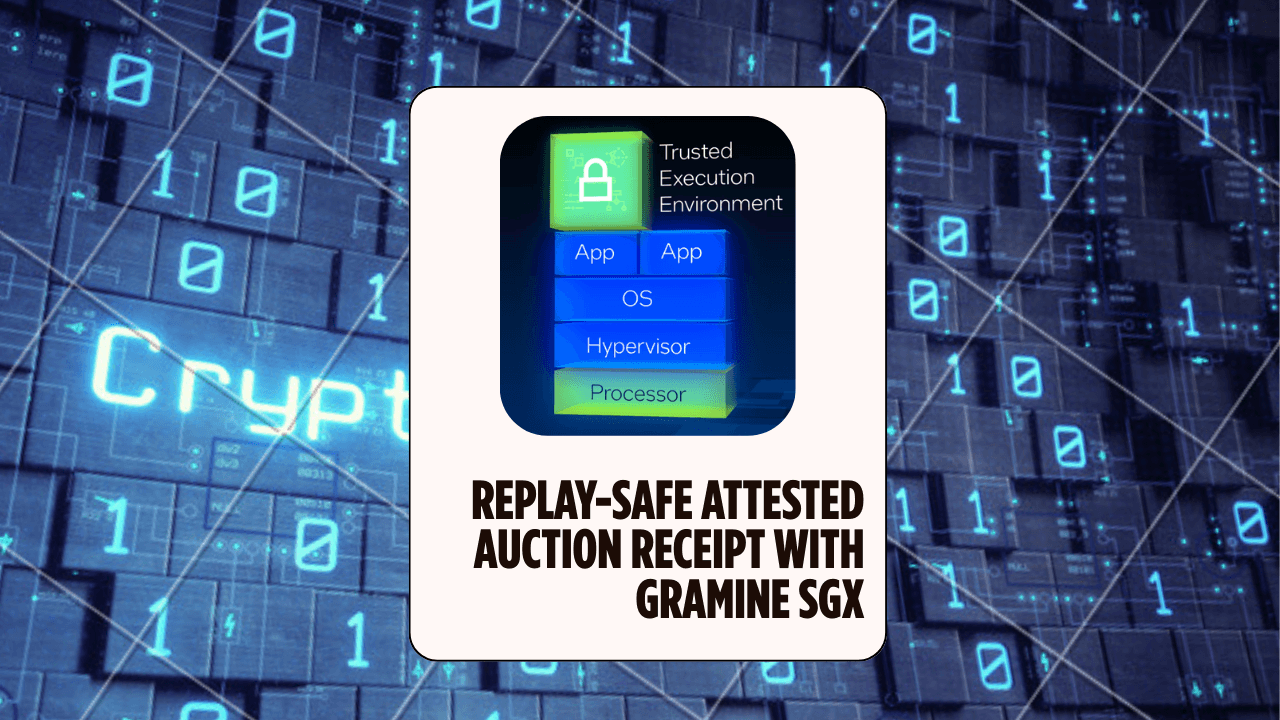
TEE Auction Coprocessor: Replay-Safe Attested Auction Receipt with Gramine SGX — Tutorial
TL;DR — This is a tutorial for building a tiny “TEE coprocessor” for a sealed-bid, second-price (Vickrey) auction:
auction-core: the trusted computation (auction + canonical bid commitment + statement hashing).enclave-auction: runs inside Gramine; emits a single JSON “receipt” (EnclaveResponse).attestation-verifier: the security referee; recomputes deterministically, enforces replay policy, and (when SGX evidence exists) parses an SGX quote and checks thatreport_databinds the receipt to the quote bytes (quote authenticity via DCAP/QVL is deferred)..- Left for the follow-up: full DCAP collateral/TCB verification (PCS chain, revocation, freshness rules), hardened production manifests, and a secure bid ingress channel (RA-TLS / encrypted bids / sealed files).
Repo: https://github.com/reymom/tee-auction-lab
What this tutorial verifies (and what it deliberately does not)
This tutorial focuses on integrity + replay safety. Confidentiality requires a secure ingress path (e.g., RA-TLS) and is intentionally deferred.
Attestation scope note: In this tutorial, “attested mode” means “a quote is present and parsed, and we check application binding (
report_data) and policy allowlists against fields extracted from that quote.” We do not verify quote authenticity (QVL) or DCAP collateral / TCB status here; that end-to-end verification is deferred to a follow-up.
What we verify end-to-end (deterministically, in all modes)
- Deterministic semantics: the result is exactly
run_second_price_auction(bids)for the providedbids.json. - Canonical commitment: the verifier recomputes
bids_commitment_hexfrom canonicalized bids and rejects tampering. - Binding at the application layer: the receipt includes
statement_hash_hexbinding (auction_id,nonce,bids_commitment_hex,result).
What we verify in “attested mode”
- The receipt's
statement_hash_hexis bound into the SGX quote viareport_data(64B), and the verifier recomputes and checks this binding (binding to quote bytes; quote authenticity / collateral verification is deferred). - The verifier enforces an explicit trust policy by allowlisting MRENCLAVE extracted from the quote (full DCAP collateral / TCB verification is deferred).
- Replay protection is enforced via
replay_db.json(reject reusedauction_id + nonceper policy).
What we do NOT claim yet (intentionally deferred)
- Full DCAP chain / TCB validation: we do not validate Intel PCS collateral end-to-end (certificate chain, revocation, TCB status/freshness). This is required for production and is deferred to a follow-up.
- Production hardening: debug enclaves (
sgx.debug = true), hardened manifests, minimal trusted files, and operational hygiene are not the focus here. - Confidential bid ingress: bids are provided as a host-side plaintext file (
bids.json). A TEE does not magically make plaintext inputs confidential from the host that supplies them.
1. Motivation: why this is a “TEE coprocessor” pattern
A private auction is the smallest non-trivial program where TEEs actually earn their keep:
- Privacy: bids should remain hidden from the host OS / cloud provider.
- Integrity: the result should come from the intended binary/config, not a modified one.
- Statefulness pitfalls: even valid attestations can be replayed unless you design replay protection from day one.
The key design principle is the coprocessor pattern:
The host is a dumb orchestrator. The verifier is the decider.
The enclave produces a small receipt (output + evidence), and the verifier decides what to accept.
2. Repository layout (one trust boundary line)
Current workspace:
tee-auction-lab/
  auction-core/           # pure function + commitments + statement hashing
  enclave-auction/        # emits EnclaveResponse, optionally collects quote
  host-cli/               # generates bids, runs enclave, writes artifacts
  attestation-verifier/   # canonical verifier + replay DB + policy enforcement
  gramine/                # manifest template + build/sign glue
  policy.dev.toml         # dev policy (no evidence required)
  policy.sgx.toml         # SGX policy (evidence required + MRENCLAVE allowlist)
  replay_db.json          # verifier state (replay protection)
One-liner pipeline:
(bidders) -> bids.json --(untrusted host)--> enclave-auction (Gramine/SGX) -> enclave_output.json
                                       |                                         |
                                       +--------------> attestation-verifier <---+
                                                (canonical acceptance)
3. Prerequisites
3.1 Local development (no SGX required)
- Rust toolchain (stable via
rustup) - A working Linux environment for Gramine direct mode (optional, but recommended for parity)
3.2 SGX VM deployment (to reproduce the attested-mode run)
- An SGX-enabled environment with driver support (e.g. Azure Confidential VMs)
- Gramine built with SGX + DCAP support
- Presence of SGX devices (
/dev/sgx_enclave,/dev/sgx_provision) and Gramine attestation files (/dev/attestation/*inside the enclave)
Deployment references (for later):
- Gramine cloud deployment guide: https://gramine.readthedocs.io/en/v1.4/cloud-deployment.html
- Azure VM sizes (DCsv2 / DCsv3 families):
3.3 Azure SGX VM: exact machine + sanity checks (DCsv3 / West Europe)
For the “attested mode” run (Gramine in SGX mode plus DCAP quote emission via Gramine's attestation interface), I used an Azure Confidential Computing VM from the DCsv3 family.
VM sizing
- VM size: Standard DC2s v3
- vCPU / RAM: 2 vCPU, 16 GiB RAM
- Region: West Europe
- Pricing note: on pay-as-you-go this was roughly “tens of cents per hour” at the time of the demo; always verify current pricing in the Azure portal because it varies by region and offer.
OS image
- Distro: Ubuntu Server 22.04 LTS (Gen2)
- Publisher / offer / plan: Canonical /
0001-com-ubuntu-server-jammy/22_04-lts-gen2 - Kernel (example):
6.8.0-1044-azure(kernel revisions can change over time as Azure images update)
Security profile (host-side)
- “Trusted launch” security type (Secure Boot + vTPM enabled). This is orthogonal to SGX itself, but it is a reasonable default hardening baseline for cloud hosts.
SGX/Gramine readiness checks on the VM
The minimum host-side checks I ran before attempting Gramine SGX execution:
# OS / kernel sanity
uname -a
uname -r

# SGX device exposure on the host (required for in-VM SGX enclaves)
ls -la /dev/sgx* || true

# CPU feature bits should include sgx (+ typically sgx_lc on modern platforms)
egrep -m1 -i 'sgx|sgx_lc' /proc/cpuinfo || true

# Gramine toolchain presence
gramine-sgx --version

# Gramine’s own end-to-end environment check
is-sgx-available
Expected outcome:
/dev/sgx_enclaveand/dev/sgx_provisionare present on the host.is-sgx-availablesucceeds (exit code 0) and reports SGX as available.
On my VM, the host exposed /dev/sgx_enclave and /dev/sgx_provision (modern in-kernel SGX driver path; legacy /dev/isgx was not present).
On this VM, the check succeeded (exit_code=0) and confirmed:
- SGX1 + SGX2 supported
- Flexible Launch Control supported
- SGX driver loaded
- AESM daemon available (service
aesmd) - SGX PSW / libsgx installed
- EPC present (SGX enclave page cache)
This is the fastest way to establish “the platform is SGX-capable and the software stack is present”.
Note: You may see warnings about the Quote Provider Library (e.g.,
libdcap_quoteprov.so). These are typically resolved by installing the default DCAP Quote Provider Library package for your distro and ensuring the expected.soname is present vialdconfig/symlinks. This matters because quote generation (and full verification in a follow-up) relies on the right collateral.
On Ubuntu, the quick fix is typically installing libsgx-dcap-default-qpl and ensuring libdcap_quoteprov.so resolves via ldconfig.
Gramine SGX smoke test: CI-Examples/helloworld
Next, I ran Gramine's canonical SGX sample to confirm that:
- manifest generation works,
- SGX signing works, and
- the enclave actually executes under
gramine-sgx.
# Gramine version sanity
gramine-sgx --version

# Build + sign the enclave-wrapped sample
cd ~/gramine/CI-Examples/helloworld
make clean
make SGX=1

# Run inside an SGX enclave via Gramine
gramine-sgx helloworld
Successful run (abridged):
Gramine 1.9 (...)

gramine-sgx-sign ... --output helloworld.manifest.sgx
Measurement:
    b81f2f7b...

gramine-sgx helloworld
Gramine detected the following insecure configurations:
  - sgx.debug = true (this is a debug enclave)
Hello, world
Two important takeaways:
Measurementis printed at signing time. This is the enclave measurement you would pin in a policy allowlist for production-like deployments (exact field depends on the attestation format/policy).- The warning about
sgx.debug = trueis expected for a tutorial/sample. Debug enclaves are convenient for development but are not appropriate for production security claims.
With this smoke test passing, I consider the SGX VM “known good” for running the auction enclave under Gramine SGX. From here, the remaining work is application-specific (manifest hardening, trusted file set, and—when enabled—DCAP quote emission and report_data binding checks).
Reproducing the exact SGX run for this repo
# From repo root on the SGX VM:
cd ~/tee-auction-lab
chmod +x scripts/run_enclave_sgx.sh

# 1) Build + sign + run enclave under SGX (writes enclave_output.json + gramine_sgx.log)
AUCTION_ID="auction-123" AUCTION_NONCE="nonce-abc" ./scripts/run_enclave_sgx.sh

# scripts/run_enclave_sgx.sh runs the enclave under SGX and writes enclave_output.json.
# It also runs verify-local as a quick determinism check; the policy gate is demonstrated below with verify-policy.

# 2) Confirm receipt is valid JSON and includes SGX evidence
jq . enclave_output.json >/dev/null && echo "JSON OK"
jq -r '.evidence.quote_base64 | length' enclave_output.json
# Example: 6312

# 3) Pin enclave identity (MRENCLAVE) in policy
# Copy the "Measurement:" hex printed by gramine-sgx-sign during the script run.
# Example measurement:
#   7343cf214e94e3efe8486fc0e323e16f242e493fe1e66d2e4524fd3d90cdca85
# Put it into policy.sgx.toml under allowed_mrenclaves.

# 4) Verify in policy mode (attested) + record replay state
rm -f replay_db.json  # optional: reset for a clean demo
cargo run -p attestation-verifier -- verify-policy \
  --policy policy.sgx.toml \
  --replay-db replay_db.json \
  --bids bids.json \
  --enclave-output enclave_output.json

# 5) Replay protection demo: run the same verification again -> should fail
cargo run -p attestation-verifier -- verify-policy \
  --policy policy.sgx.toml \
  --replay-db replay_db.json \
  --bids bids.json \
  --enclave-output enclave_output.json
# Expected: Error: REPLAY DETECTED: already used auction_id+nonce
Notes:
verify-localis determinism-only (no evidence requirement).verify-policyis the evidence-required flow: requires a quote, checks report_data binding, and enforces MRENCLAVE allowlisting (full DCAP/QVL verification deferred).
Identity pinning note
MRENCLAVE is the enclave measurement over the enclave's initial contents (as reflected in the quote). Any change to the enclave binary, manifest, or trusted file set changes the measurement.
After rebuild/re-sign, copy the new Measurement: printed by gramine-sgx-sign into policy.sgx.toml.
Otherwise we get:
Error: MRENCLAVE not allowed by policy: <measurement>Example:
[enclave_identity]
mode = "mrenclave"
allowed_mrenclaves = [
  "7343cf214e94e3efe8486fc0e323e16f242e493fe1e66d2e4524fd3d90cdca85"
]
4. The receipt format: EnclaveResponse (the contract)
Everything revolves around a single struct emitted by the enclave and consumed by the verifier.
// auction-core/src/lib.rs (excerpt)
use serde::{Deserialize, Serialize};

#[derive(Debug, Clone, Serialize, Deserialize, PartialEq, Eq)]
pub struct AuctionResult {
    pub winner_id: String,
    pub clearing_price: u64,
    pub highest_bid: u64,
    pub second_highest_bid: u64,
}

#[derive(Debug, Clone, Serialize, Deserialize, PartialEq, Eq)]
pub struct SgxDcapEvidence {
    /// Base64-encoded raw quote bytes read from `/dev/attestation/quote`.
    pub quote_base64: String,
}

#[derive(Debug, Clone, Serialize, Deserialize, PartialEq, Eq)]
pub struct EnclaveResponse {
    pub auction_id: String,
    pub nonce: String,

    pub result: AuctionResult,
    pub bids_commitment_hex: String,

    /// Hash of a domain-separated statement binding inputs + output.
    pub statement_hash_hex: String,

    /// Present only when running under SGX with quote generation enabled.
    pub evidence: Option<SgxDcapEvidence>,
}
Interpretation:
bids_commitment_hexis the public commitment to the canonical bid set.statement_hash_hexbinds(auction_id, nonce, bids_commitment_hex, result)into one hash.- In dev/local mode,
evidenceis typically null. On SGX+DCAP, the receipt includes evidence.quote_base64. Just confirm it via:
jq -r '.evidence.quote_base64 | length' enclave_output.json5. Determinism: canonical bid commitment
If bids arrive in different orders, you still want the same commitment.
We canonicalize bids, then commit to the JSON serialization:
// auction-core/src/lib.rs (excerpt)
use sha2::{Digest, Sha256};

#[derive(Debug, Clone, Serialize, Deserialize, PartialEq, Eq)]
pub struct Bid {
    pub bidder_id: String,
    pub amount: u64,
}

fn canonicalize_bids(bids: &[Bid]) -> Vec<Bid> {
    let mut v = bids.to_vec();
    v.sort_by(|a, b| a.bidder_id.cmp(&b.bidder_id).then_with(|| a.amount.cmp(&b.amount)));
    v
}

pub fn bids_commitment(bids: &[Bid]) -> [u8; 32] {
    let canonical = canonicalize_bids(bids);
    let bytes = serde_json::to_vec(&canonical).expect("bids must serialize");
    let mut hasher = Sha256::new();
    hasher.update(&bytes);
    hasher.finalize().into()
}
This is the bridge between:
- an untrusted host that shuffles files and processes, and
- a verifier that can recompute and reject tampering.
6. The statement we bind into SGX report_data
SGX gives you exactly 64 bytes of report_data. The coprocessor pattern needs you to bind your application statement into this field.
We define a domain-separated statement and hash it:
// auction-core/src/lib.rs (excerpt)
#[derive(Debug, Clone, Serialize)]
struct AuctionStatement<'a> {
    domain: &'a str,
    auction_id: &'a str,
    nonce: &'a str,
    bids_commitment_hex: &'a str,
    result: &'a AuctionResult,
}

pub fn statement_hash_hex(
    auction_id: &str,
    nonce: &str,
    bids_commitment_hex: &str,
    result: &AuctionResult,
) -> String {
    let st = AuctionStatement {
        domain: "tee-auction-v1",
        auction_id,
        nonce,
        bids_commitment_hex,
        result,
    };

    let bytes = serde_json::to_vec(&st).expect("statement JSON");
    let mut hasher = Sha256::new();
    hasher.update(&bytes);
    hex::encode(hasher.finalize())
}

/// SGX `report_data` is 64 bytes; we use `hash || hash` (32B + 32B).
pub fn report_data_64_from_statement_hash(statement_hash_hex: &str) -> [u8; 64] {
    let mut out = [0u8; 64];
    let h = hex::decode(statement_hash_hex).expect("hex");
    assert_eq!(h.len(), 32, "SHA-256 is 32 bytes");
    out[..32].copy_from_slice(&h);
    out[32..].copy_from_slice(&h);
    out
}
Why hash || hash?
- It fills 64 bytes without inventing a second independent value.
- The security property is the binding: quote
report_datamust match this 64-byte value.
7. Enclave logic: compute receipt, optionally collect SGX quote
Enclave flow:
- Read bids from
ENCLAVE_BIDS_PATH(or default path) - Require
AUCTION_IDandAUCTION_NONCE - Compute
result,bids_commitment, andstatement_hash - Compute
report_data_64fromstatement_hash - If running under SGX + Gramine DCAP attestation, write report_data and read quote
- Emit
EnclaveResponseJSON to stdout
Key excerpt:
// enclave-auction/src/main.rs (excerpt)
let result = run_second_price_auction(&bids);
let bids_commitment_hex = hex::encode(auction_core::bids_commitment(&bids));

let statement_hash_hex = statement_hash_hex(&auction_id, &nonce, &bids_commitment_hex, &result);
let report_data_64 = report_data_64_from_statement_hash(&statement_hash_hex);

let evidence = try_collect_dcap_quote(&report_data_64)
    .context("failed to collect DCAP quote")?;

let response = EnclaveResponse {
    auction_id,
    nonce,
    result,
    bids_commitment_hex,
    statement_hash_hex,
    evidence,
};

println!("{}", serde_json::to_string_pretty(&response)?);
Note: The enclave prints the JSON receipt to stdout (so the host can capture it as a file). Any debugging should go to stderr so it doesn't corrupt the receipt.
Quote collection is explicitly gated on the presence of Gramine's attestation files:
// enclave-auction/src/main.rs (excerpt)
fn try_collect_dcap_quote(report_data_64: &[u8; 64]) -> Result<Option<SgxDcapEvidence>> {
let quote_path = Path::new("/dev/attestation/quote");
let user_report_data_path = Path::new("/dev/attestation/user_report_data");
if !quote_path.exists() || !user_report_data_path.exists() {
return Ok(None); // dev / non-SGX mode
}
// 1) Bind our statement hash into SGX report_data (must be exactly 64 bytes).
{
let mut f = File::create(user_report_data_path)?;
f.write_all(report_data_64)?;
f.flush().ok();
}
// 2) Read the DCAP quote bytes.
let mut quote_file = File::open(quote_path)?;
let mut quote_bytes = Vec::new();
quote_file.read_to_end(&mut quote_bytes)?;
Ok(Some(SgxDcapEvidence {
quote_base64: base64::engine::general_purpose::STANDARD.encode("e_bytes),
}))
}This avoids pretending to have SGX evidence in local mode: locally evidence is null; on an SGX VM it becomes populated.
8. The verifier: recompute, enforce replay policy, and bind evidence
8.1 The verifier is canonical by design
The host is not a verifier; it just runs the enclave and stores artifacts.
The verifier:
- reads
bids.jsonandenclave_output.json - recomputes commitment, result, statement hash
- enforces replay rules
- if evidence exists: parses quote and checks report_data binding
- enforces identity policy (allowlist) when evidence exists
8.2 The “undeniable” check: quote report_data must match expected
This is the core coprocessor evidence check:
// attestation-verifier/src/main.rs (excerpt)
let expected_commitment_hex = hex::encode(auction_core::bids_commitment(&bids));
let expected_result = run_second_price_auction(&bids);
let expected_statement_hash = statement_hash_hex(
&resp.auction_id,
&resp.nonce,
&expected_commitment_hex,
&expected_result,
);
let expected_report_data = report_data_64_from_statement_hash(&expected_statement_hash);
// Evidence required for attested mode
let evidence = resp.evidence.as_ref().context("missing evidence")?;
let quote_bytes = base64::engine::general_purpose::STANDARD
.decode(&evidence.quote_base64)?;
// Parse quote and read report_data
let quote = sgx_quote::Quote::parse("e_bytes)
.map_err(|e| anyhow::anyhow!("quote parse error: {e:?}"))?;
let report_data = quote.isv_report.report_data;
if report_data != expected_report_data {
anyhow::bail!("quote report_data mismatch (statement not bound to evidence)");
}If this passes, you have:
- a receipt (statement) that matches deterministic recomputation, and
- evidence that is cryptographically bound to that receipt via
report_data.
That is the essence of “TEE as coprocessor”.
9. Replay protection: boring state, correct behavior
Attested results can be replayed unless you store state. We implement this explicitly with a persistent DB (replay_db.json).
Two useful replay policies:
- strict: unique
auction_id - relaxed: unique
(auction_id, nonce)
The policy is versioned and lives in policy.toml.
Example policy.toml:
version = 1

[replay]
# If true, reject any second receipt with same auction_id (strongest, simplest).
# If false, replay key can be auction_id::nonce.
auction_id_unique = true

[enclave_identity]
# When evidence exists, enforce identity allowlist.
mode = "mrenclave"
allowed_mrenclaves = [
  # Filled after SGX VM run (real measurement hex)
  # "532a135d...f9def6b"
]
The verifier only records replay state after all checks pass:
// attestation-verifier (conceptual excerpt)
let replay_key = if policy.replay.auction_id_unique {
    resp.auction_id.clone()
} else {
    format!("{}::{}", resp.auction_id, resp.nonce)
};

if used.contains(&replay_key) {
    anyhow::bail!("REPLAY DETECTED: {}", replay_key);
}

// only after deterministic + (optional) evidence checks succeed:
used.insert(replay_key);
save_replay_db(...)?;
This is the discipline we want in a “rollup node” style verifier.
10. Host orchestration: produce artifacts, do not become the verifier
The host CLI's job is:
- produce
bids.json - run enclave
- store enclave stdout as
enclave_output.json
Minimal tutorial flow:
# 1) Create bids
cargo run -p host-cli -- gen-sample-bids

# 2) Run enclave locally (plain process runner)
cargo run -p host-cli -- run-local --bids bids.json --out enclave_output.json

# 3) Verify deterministically (no evidence required)
cargo run -p attestation-verifier -- verify-local \
  --bids bids.json \
  --enclave-output enclave_output.json

# Optional: exercise replay DB + policy logic locally (dev policy)
cargo run -p attestation-verifier -- verify-policy \
  --policy policy.dev.toml \
  --replay-db replay_db.json \
  --bids bids.json \
  --enclave-output enclave_output.json
In local mode we should see:
evidence: nullinenclave_output.json- verifier passes deterministic checks and records replay state
11. Gramine / SGX integration: what we already have (and what the SGX-enabled VM run adds, see above)
We already have the correct manifest building blocks:
- passthrough env vars (
AUCTION_ID,AUCTION_NONCE,ENCLAVE_BIDS_PATH) sgx.remote_attestation = "dcap"- trusted file declarations (for integrity + measurement)
- the signed manifest (
*.manifest.sgx) and measurement printed bygramine-sgx-sign
When we ran:
make build copy-bids manifest signand got a printed Measurement, we proved:
- the enclave configuration is “measurable” and reproducible
- we have a concrete value to pin in a policy allowlist
The next step that fails on my laptop (missing driver) is exactly the step that will succeed in an SGX-ready VM:
AUCTION_ID="auction-123" AUCTION_NONCE="nonce-abc" ENCLAVE_BIDS_PATH="/bids.json" gramine-sgx enclave-auction > ../enclave_output.jsonOn an SGX VM with drivers:
/dev/sgx_enclaveexists on the host- Gramine can launch the enclave
/dev/attestation/*exists in the enclaveenclave_output.jsonshould now contain non-nullevidence.quote_base64
At that point, we flip the policy:
- add the real MRENCLAVE to
allowed_mrenclaves - run verifier again, now enforcing identity based on evidence
Confidentiality: what SGX does not magically give you
A crucial limitation of the current tutorial is that bids are supplied as a plaintext host file (bids.json) and mounted into the enclave.
This means:
- SGX protects in-enclave memory and prevents the host OS from reading enclave RAM directly.
- But the host still sees plaintext inputs before they enter the enclave (because it created or stored
bids.json).
So the current tutorial demonstrates integrity + replay safety, but not bid confidentiality.
What “confidential bids” would require (follow-up options)
Any of the following patterns is acceptable; the right choice depends on your product constraints:
-
RA-TLS bid submission (recommended)
- The enclave runs a small TLS server.
- Bidders establish an RA-TLS connection and only send bids after verifying enclave identity (measurement/policy).
- The host sees ciphertext only.
-
Encrypted bids + in-enclave decryption
- Bidders encrypt their bid to an enclave public key.
- The enclave holds the private key (sealed to disk if needed).
- The host stores ciphertext blobs, not plaintext bids.
-
Sealed file input
- If bids must be file-based, encrypt and seal them to the enclave.
- This still needs a secure way to provision the key (which typically means remote attestation anyway).
Until one of these is implemented, you should not describe the system as a “private auction” end-to-end; it is currently an integrity-focused coprocessor receipt with replay protection.
12. VM-ready next steps (fast checklist)
This is the minimum “SGX-ready” checklist to finish the tutorial and make the follow-up post mostly copy/paste:
-
Add a host runner mode for SGX
- Option A:
host-cli run-sgx ...that shells out togramine-sgx enclave-auction - Option B: a small script that runs
make run-sgx AUCTION_ID=... AUCTION_NONCE=...
- Option A:
-
Run on an SGX VM and obtain a quote
- confirm
/dev/sgx_enclaveon host - confirm
/dev/attestation/quoteinside enclave - verify
evidence.quote_base64becomes non-null
- confirm
-
Pin measurement
- extract MRENCLAVE from quote (verifier already prints it in attested mode)
- put it into
policy.tomlallowlist - demonstrate:
- wrong measurement fails
- replay attempt fails
-
Only then (follow-up): full DCAP chain verification
- validate quote signature chain and TCB status
- document vendor roots + freshness rules
13. Resources
Primary references used while building this lab:
- Gramine project: https://gramineproject.io/
- Gramine cloud deployment: https://gramine.readthedocs.io/en/v1.4/cloud-deployment.html
- Driver installation: https://cc-enabling.trustedservices.intel.com/intel-sgx-sw-installation-guide-linux/02/installation_instructions/
- Azure DCsv3 sizes: https://learn.microsoft.com/en-us/azure/virtual-machines/sizes/general-purpose/dcsv3-series?tabs=sizebasic
- Andrew Miller Gramine RSA demo (pattern reference): https://github.com/amiller/gramine-rsademo
Appendix: “professional claim” summary (for a DM)
This repo is not “production-grade SGX attestation.” It is:
- A minimal coprocessor interface (receipt struct) with deterministic recomputation.
- A clean binding story:
statement_hash -> report_data -> quote. - A verifier that behaves like a policy-driven rollup node: replay-aware, explicit trust policy, upgrade-ready allowlists.
- A clear scope boundary: full DCAP chain/TCB verification is acknowledged and intentionally postponed for a follow-up.
- A clearly scoped tutorial: SGX execution + deterministic receipt verification now; quote emission, report_data binding, and full DCAP chain verification next.
# related
A DarkFi Node on a Raspberry Pi — ARM Bring-Up Notes and the Circuits Underneath
Notes from turning a Raspberry Pi 5 into a 24/7 DarkFi testnet node and miner: NVMe boot, self-hosted WireGuard, the ARM dependency trail for darkfid and xmrig, and a look at the ZK circuits the node deploys on startup — including the v3a exploit that sat on a Poseidon binding.
Bytes, Bits, and Breaking XOR — Notes from Cryptopals in Rust
Notes from implementing the first Cryptopals challenges in Rust without libraries: hex, base64, XOR, frequency analysis, Hamming distance, and breaking a repeating-key cipher.
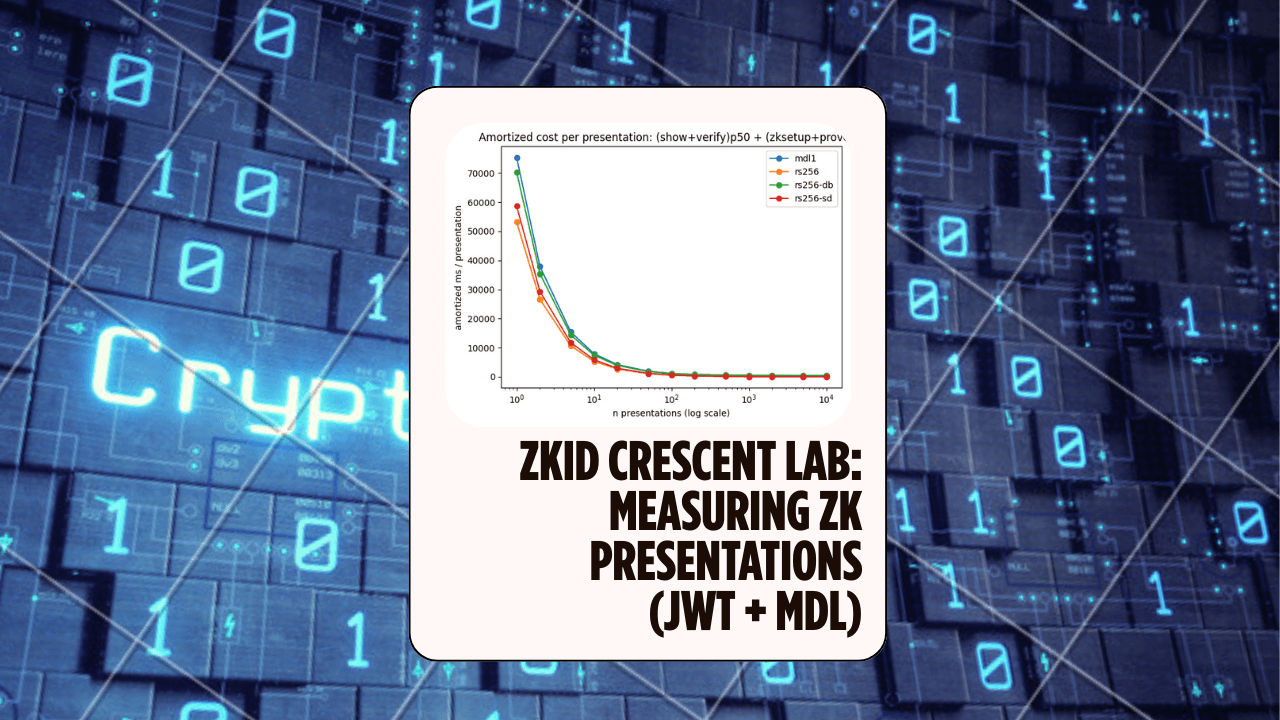
Crescent Bench Lab: Measuring ZK Presentations for Real Credentials (JWT + mDL)
A small Rust lab that vendors microsoft/crescent-credentials, generates Crescent test vectors, and benchmarks zksetup/prove/show/verify across several parameters — including proof sizes and selective disclosure variants.